 EN
EN

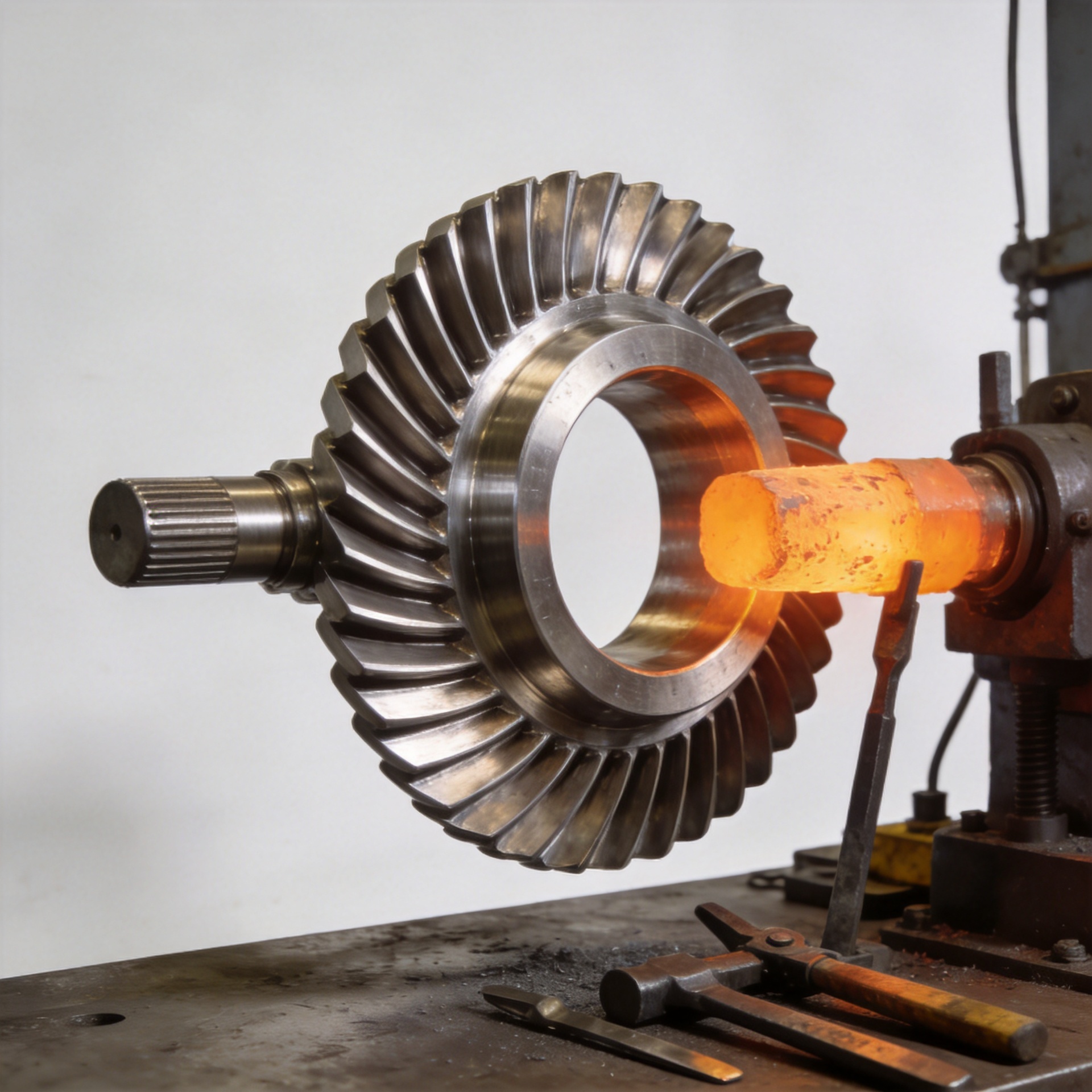
How To Control Deformation During forged inconel rotor Forging Process?
Anyone who has spent time on a press shop floor watching a forged inconel rotor emerge from the die knows the quiet tension that follows. You have held the temperature, managed press speed, and still, the part comes out with a profile that drifts beyond tolerance. Dimensional consistency in Inconel rotor manufacturing is one of those challenges that looks manageable on a specification sheet but reveals its real difficulty under production conditions.
This article outlines the practical mechanisms for achieving deformation control in the forged inconel rotor manufacturing sequence: heat management, strain rate discipline, tooling design, and post-forming stabilization: factors that determine whether a finished turbine disc meets dimensional requirements — not the temperature listed on a parameter sheet but rather how consistently those inputs are maintained in practice.
Why Inconel Rotor Manufacturing Requires Careful Dimensional Management
The difficulty in forged inconel rotor production has a material basis. IN718's flow resistance drops significantly with increasing forming temperature or decreasing strain rate — reaching approximately 260 MPa at 1000°C under typical hot-working conditions. That sensitivity means small temperature gradients across the billet cross-section produce disproportionate local differences in metal flow, leading to non-uniform shape development and dimensional scatter across the finished disc.
Industrial manufacturing of IN718 uses the delta (δ) phase solvus temperature — approximately 1010°C to 1020°C — as the upper reference boundary for the hot-working window. Operating above the delta solvus risks uncontrolled grain growth; too far below it produces rapid work hardening and cracking. The effective manufacturing window for a forged inconel rotor is roughly 50–80°C wide, which demands systematic management rather than loose parameter handling.
Temperature Management in the Thermal Forging Process
Heat distribution is the primary variable in forged inconel rotor production. Uniform temperature through the billet cross-section (not just at the surface) determines how metal moves across the disc geometry during each pressing hit. Shapes with hub, web, and rim sections of varying thickness are particularly vulnerable: cooler zones resist forming while hotter zones accommodate strain preferentially, creating flow gradients that translate directly to dimensional variation.
Effective management in the thermal forging process requires several disciplines:
- Full-section soak time: The billet must reach a uniform hot-working temperature through its entire cross-section before the first press hit. Incomplete soaking is a routine cause of dimensional lag in thick hub sections, where the center temperature falls behind the surface during furnace heating.
- Transfer time limitation: Surface cooling during billet transfer from furnace to press drops temperature several degrees per second. For most mid-size preforms in forged inconel rotor applications with tight tolerances, transfer time should typically remain under 30 seconds.
- Inter-pass reheat scheduling: Multi-hit forming of complex disc profiles requires careful reheat sequences between pressing operations. The cumulative heat history across all hits determines the microstructure and residual stress state of the finished part, not just the final hit temperature.
Strain Rate and Press Velocity
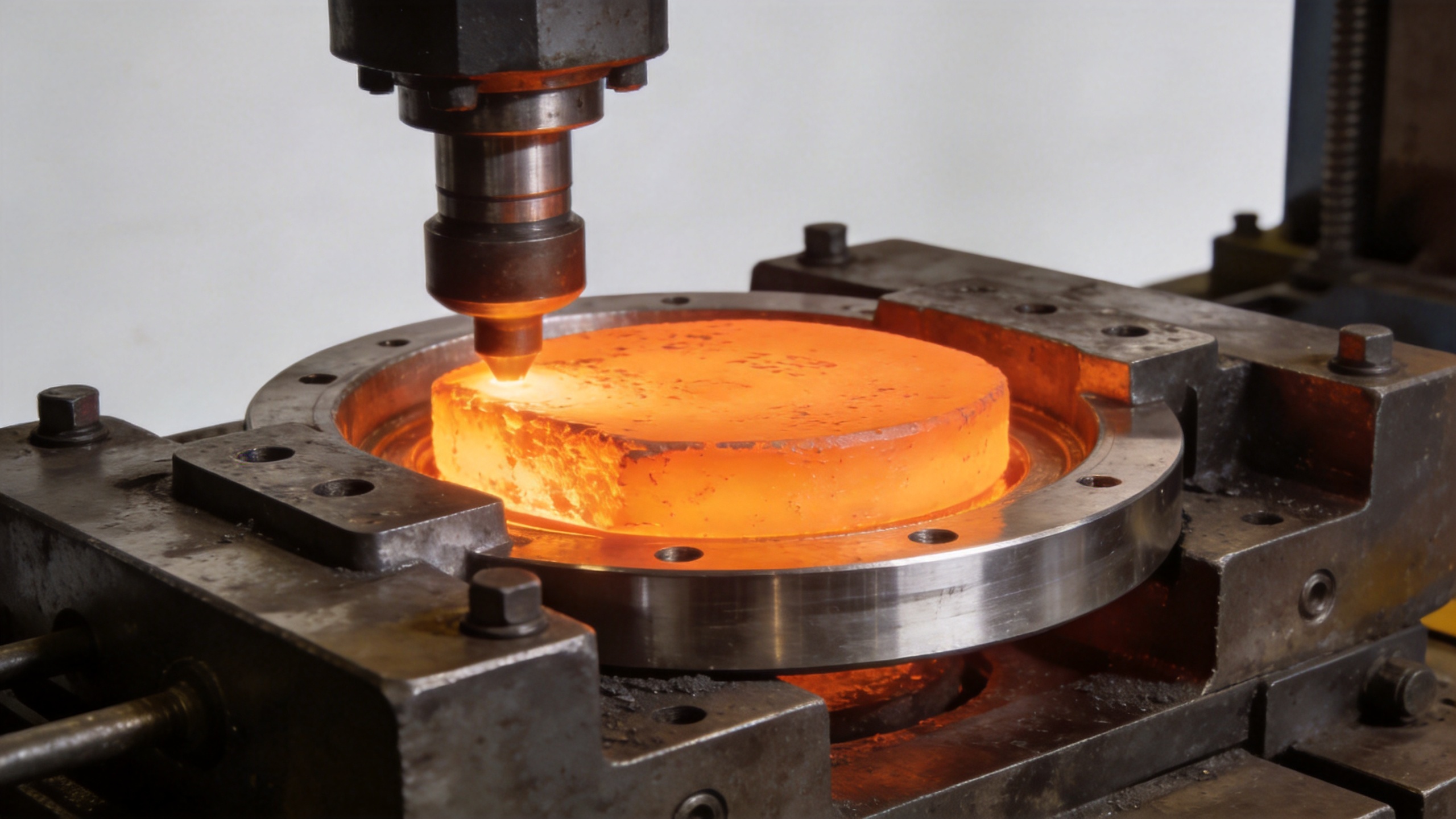
Achieving deformation control in forged inconel rotor manufacturing cannot rely on heat management alone. Strain rate, meaning the speed at which material is worked during each press hit, directly determines whether IN718 flows uniformly or develops localized shear bands and precursors to surface cracking.
At excessive press speeds, adiabatic heat buildup in active deformation zones can elevate local temperatures above the delta solvus in thin disc sections, even when the bulk billet temperature remains within the thermal forging process window. This failure mode is well-recognized in disc and web geometries and explains why hydraulic presses — offering hit-by-hit velocity regulation — are the standard choice for precision forged inconel rotor applications requiring close dimensional management.
Key variables for managing rate-related dimensional outcomes:
- Ram velocity selection: Reduced press speed at initial die contact improves uniformity by slowing adiabatic heat generation in thin sections during first-contact forming.
- Pass reduction strategy: Distributing total reduction across more press hits allows better dimensional management at each stage, at the cost of longer cycle times that experienced forged inconel rotor manufacturers typically accept for high-criticality components.
- Directional pressing orientation: Aligning the primary reduction direction with the intended grain flow axis improves both profile consistency and final mechanical properties, which is standard practice for turbine disc geometries.
Die Design and Tooling Temperature
Tooling choices affect dimensional outcomes in forged inconel rotor manufacturing through their influence on surface chilling at die contact. Cold tooling causes rapid surface temperature drop, creating a steep gradient between skin and core that drives non-uniform metal flow even when bulk billet temperature and press speed are properly managed through the thermal forging process.
Heated dies, typically preheated to 200°C–400°C for IN718 disc work, reduce the temperature differential at the tool-billet interface, slowing surface chilling and improving metal flow uniformity. Cavity dimensions must account for IN718's contraction on cooling (approximately 13–14 mm/m across the hot-working range) to maintain accuracy after the forging cools. Glass-based lubricants applied before billet heating provide both friction management and a degree of thermal insulation during transfer, helping preserve billet temperature at the start of each press cycle.
Post-Forming Cooling and Dimensional Stabilization
A forged inconel rotor that exits the die within tolerance can still distort during cooling if the post-press sequence is not managed. Residual stress from non-uniform metal flow, combined with the alloy's expansion and contraction characteristics, can produce dimensional drift that complicates subsequent heat treatment and final machining operations.
Controlled cooling, using insulating wrap or a staged environment rather than ambient air, limits the temperature gradient across the disc cross-section during the first minutes after die extraction, reducing distortion-driving residual stress. For thick hub sections, slow cooling through the precipitation range, roughly 600°C to 900°C, also minimizes residual stress contributions to final component dimensions.
Solution annealing and aging, the standard heat treatment sequence for IN718, provides an additional opportunity to reduce press-induced residual stress, improving dimensional stability before finish machining. Forged inconel rotor suppliers who control the full sequence from pressing through heat treatment can maintain accountability for dimensional outcomes throughout the manufacturing chain, rather than handing off an unstable part at the press stage.
Inspection and Deformation Control Validation
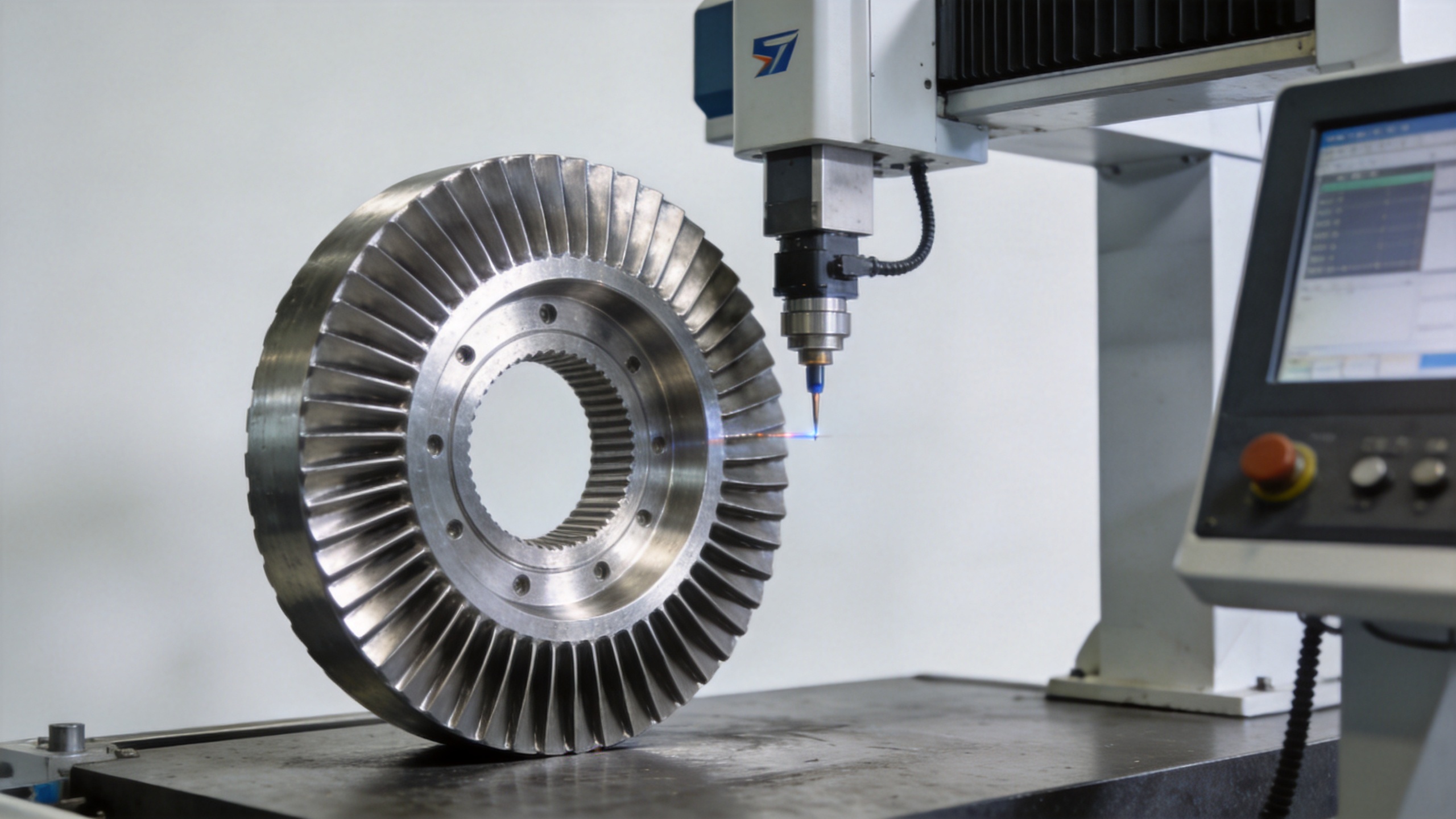
Process-based deformation control in forged inconel rotor manufacturing must be confirmed through dimensional inspection. Typical programs include 3D scanning or CMM measurement of key profile sections, dimensional checks at defined cross-sections to verify machining stock distribution, and surface condition review for indicators of forming failures — laps, cold shuts, and underfill patterns, before parts reach the machining stage.
Relying on inspection to detect forming failures is a reactive approach. Reliable dimensional management across production runs requires documented, characterized parameters for each alloy grade, billet size, and part geometry — established through systematic qualification rather than adjusted part-to-part during the thermal forging process. When evaluating forged inconel rotor suppliers, the question worth asking is not whether they can produce a compliant first article, but whether they have validated capability that delivers consistent dimensional outcomes across multiple production heats.