 EN
EN

What Material Improves Heat Resistance Of Gas Turbine Stator Vane?
When evaluating material options for a gas turbine stator vane, the spec sheet comparison only tells part of the story. Stator vanes in the turbine hot section operate in conditions where gas temperatures routinely exceed 1,093°C (2,000°F), and the combination of thermal cycling, oxidizing gas flow, and mechanical stress creates a failure environment that punishes any material weakness. For procurement engineers and MRO planners working through a component sourcing decision, the practical question is not just which alloy grade is listed in the OEM specification — it is which material system can sustain that performance across your actual operating cycle.
This article covers the four material approaches that have demonstrated meaningful heat resistance improvements for gas turbine stator vanes, along with the conditions under which each approach delivers its claimed benefit.
Nickel-Based Superalloys: The Baseline for Hot Section Stator Vanes
Nickel-based superalloys — the primary high temperature alloy class used in gas turbine construction — remain the standard material for turbine stator vanes exposed to high-temperature gas streams. The core properties that make nickel superalloys effective in this environment are creep resistance (the ability to maintain dimensional stability under sustained load at temperature), oxidation resistance, and hot corrosion resistance. These properties hold at operating temperatures that would cause conventional steels or titanium alloys to lose structural integrity rapidly.
Within the nickel superalloy family, the specific alloy grade determines the effective temperature ceiling. When sourcing a high temperature alloy for turbine hot-section components, high-generation grades — those incorporating refractory metals such as rhenium and tantalum — demonstrate higher temperature capability and improved creep strength compared to earlier-generation grades. For gas turbine stator vanes operating in the 1,093–1,204°C range, the alloy selection needs to reflect this distinction. A lower-generation nickel superalloy might match the alloy grade on paper while delivering shorter service life in a high-temperature application.
The realization that changes most procurement approaches: matching alloy grade on paper does not automatically translate to equivalent service life in your specific operating environment. Alloy grade is a starting point for qualification, not a guarantee of equivalent field performance across different suppliers or manufacturing routes.
Thermal Barrier Coatings: Extending the Effective Temperature Range
Thermal barrier coatings (TBCs) work by reducing the thermal load that reaches the underlying superalloy substrate — effectively shifting the temperature problem from the metal to the coating. A standard TBC system consists of two layers: a metallic bond coat that provides oxidation resistance and adhesion, and a ceramic topcoat — typically yttria-stabilized zirconia (YSZ) — that provides thermal insulation.
In practice, TBC systems can reduce the effective temperature at the metallic substrate by more than 200K compared to an uncoated blade operating in the same gas stream. This temperature reduction directly extends creep life and oxidation life of the underlying superalloy, allowing turbine entry temperatures in excess of 1,500K while keeping the metallic component within its reliable operating range.
If your procurement or overhaul specification calls for TBC-coated stator vanes, the coating condition on delivered components becomes a critical inspection item — not just the substrate alloy. TBC spallation or delamination removes the thermal protection the design depends on. In high-dust or particulate-loaded operating environments, TBC erosion rates increase and this guidance about coating life needs to be revisited against your actual operating conditions.
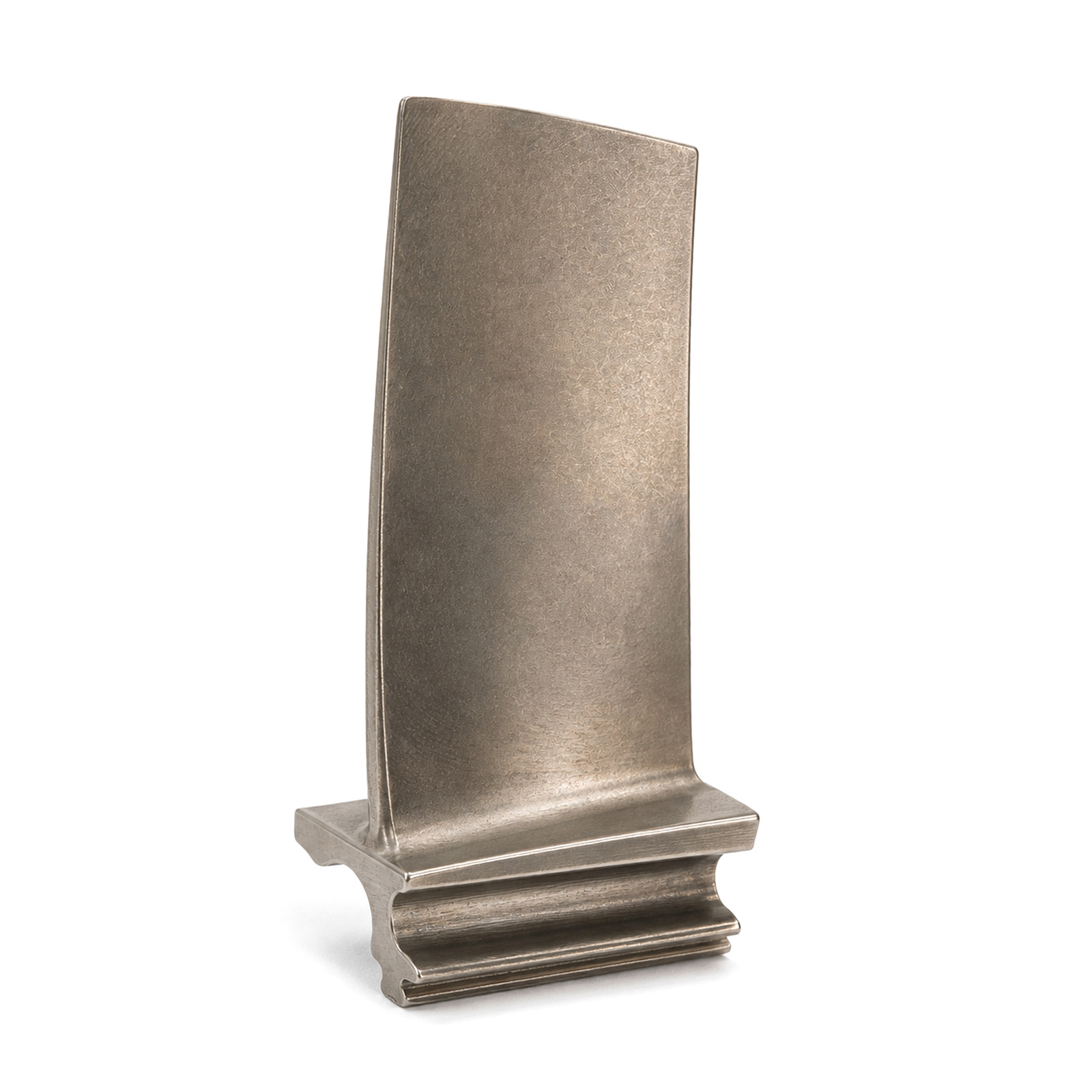 Nickel superalloy stator vane with TBC system: ceramic topcoat over metallic bond coat provides more than 200K temperature reduction at the substrate.
Ceramic Matrix Composites: Emerging Option for Extreme Temperature Applications
Ceramic matrix composites (CMCs) have moved from research programs into production service in turbine hot-section components, including stator vanes in advanced gas turbines. CMC materials — silicon carbide fiber in a silicon carbide matrix (SiC/SiC) being the most common — offer temperature capability beyond what nickel superalloys can sustain without active cooling, and at lower density.
What CMC stator vanes offer, in practice, is the ability to operate at higher gas temperatures with reduced or eliminated internal cooling requirements. This expands the design space for turbine efficiency improvement. The constraint, however, is that CMC stator vanes require manufacturing processes, inspection methods, and maintenance protocols that differ substantially from those for metallic components. For MRO service providers and operators without established CMC handling capability, the total cost of adoption extends beyond the component unit price.
So, practically speaking, what does this mean for a procurement engineer sourcing stator vanes today? CMCs are a viable selection for new advanced turbine platforms where the OEM specifies them. For legacy fleet MRO or retrofit programs, nickel superalloy with TBC remains the more broadly supported material path.
Oxidation-Resistant Coatings and Environmental Barrier Coatings
Beyond TBCs, oxidation-resistant aluminide or MCrAlY coatings applied to nickel superalloy stator vanes provide surface-level protection against the hot corrosion mechanisms that degrade base alloy properties over time. These coatings are particularly relevant for turbines operating on fuel streams with elevated sulfur or contaminant levels, where hot corrosion attack on unprotected superalloy surfaces accelerates degradation.
Environmental barrier coatings (EBCs) serve an analogous function for CMC components, protecting the silicon carbide matrix from water vapor oxidation in the combustion gas stream. EBC integrity is as operationally critical for CMC stator vanes as TBC integrity is for metallic components.
Selecting the Right Material for Your Stator Vane Application
Whether a nickel superalloy, a TBC-coated component, or a CMC stator vane fits better depends on several factors rather than a universal answer:
- Operating temperature range: For hot-section stator vanes above 1,000°C inlet temperature, high-generation nickel superalloys with TBC are the standard starting point. Turbines operating near or above the practical ceiling for metallic components are where CMC becomes relevant.
- Cooling architecture: Internally cooled stator vane designs interact directly with material selection — TBC systems extend the thermal margin for a given cooling configuration, while CMCs can reduce cooling air demand.
- Operating environment: Particulate loading, fuel quality, and humidity affect both TBC erosion rates and hot corrosion severity. These conditions should factor into coating selection and inspection intervals.
- Maintenance and supply chain: Material certification documentation, alloy grade traceability, and dimensional inspection data for stator vanes are standard deliverables from qualified precision forging suppliers. These documents enable incoming inspection and support quality investigation when needed.
Early in a procurement cycle, it is natural to focus on alloy grade as the primary selection criterion. Over multiple overhaul cycles, the more reliable predictor of total cost is the combination of material performance data, supplier traceability, and coating condition at delivery — not the nominal alloy designation alone.
Conclusion
For gas turbine stator vanes, heat resistance is delivered by a material system rather than a single material choice. Selecting the appropriate high temperature alloy provides the structural foundation; thermal barrier coatings extend the effective temperature range by insulating the substrate; CMCs offer a higher temperature ceiling for applications where metallic components reach their limits. The selection that fits your application depends on the specific temperature regime, cooling design, operating environment, and maintenance infrastructure — not on a single material ranking. If your priority is service life predictability, start with material certification traceability and coating condition standards before focusing on alloy grade alone.