 EN
EN

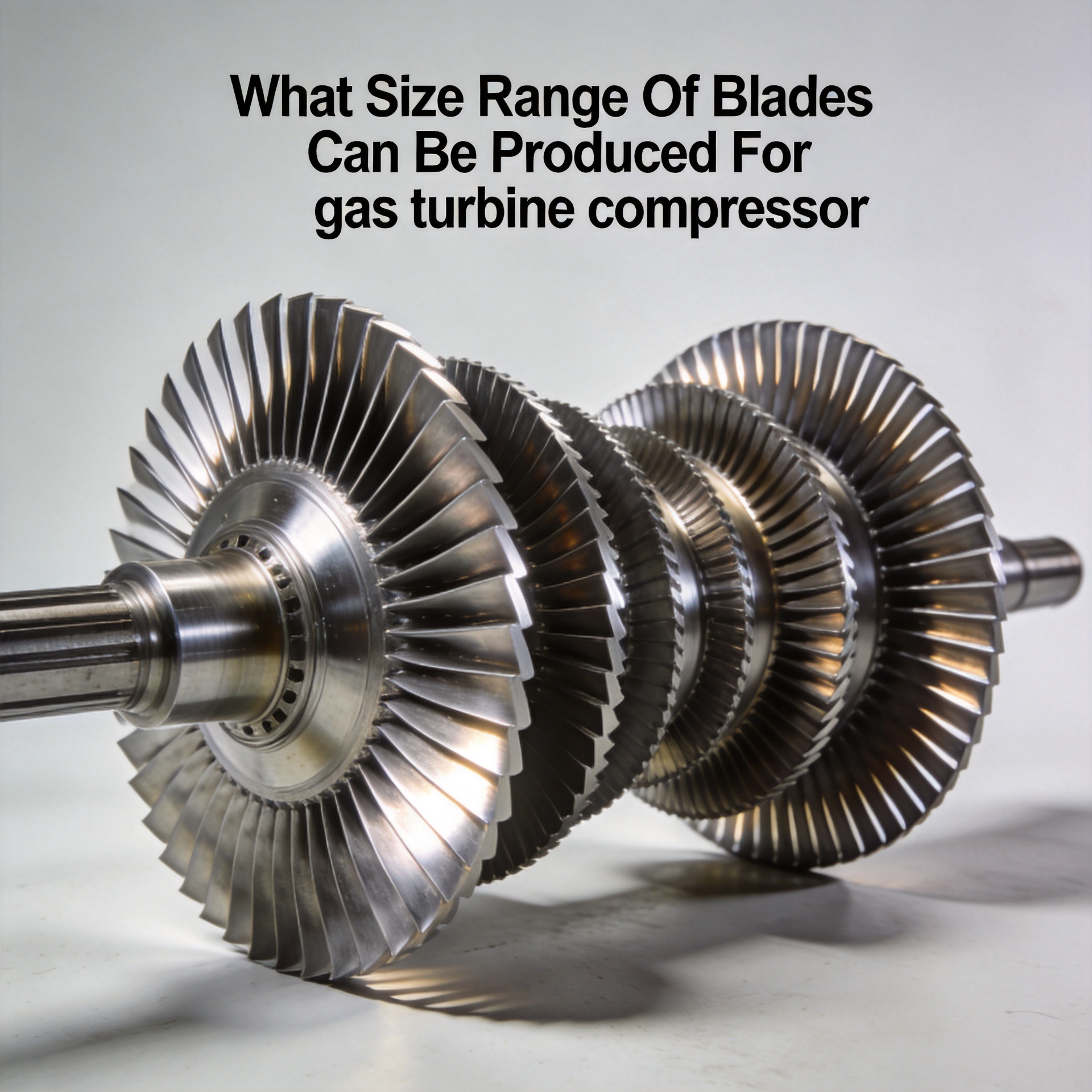
What Size Range Of Blades Can Be Produced For gas turbine compressor?
If you are sourcing replacement blades or planning a compressor retrofit, one of the first questions you ask a manufacturer is simply: how large can you make them, and how small? The answer is more nuanced than a single number. Blade size in a gas turbine compressor varies across compressor stages, across turbine power classes, and across application types. Understanding the dimensional landscape helps you frame the right conversation with your supplier — and avoid mismatched specifications before you commit to a procurement order.
This article draws on our forging production experience at Navi Power Technology to walk through the dimensional parameters that define blade size, the typical ranges seen across industrial gas turbines, and what a precision forging manufacturer can realistically produce when customers bring custom blade size requirements.
Why Blade Size Varies So Much Across a Single Compressor
A gas turbine compressor does not use one uniform blade size throughout. Because compression happens progressively across multiple stages — typically 9 to 17 stages in a large industrial turbine — the air annulus narrows from the inlet to the outlet. As the annulus shrinks, each successive stage uses shorter blades. A first-stage compressor blade in a large utility gas turbine can have a span that is four to six times longer than a blade in the final compressor stage of the same machine.
For large power-generation gas turbines operating at pressure ratios of 18:1 to 20:1, the span difference between the first and last compressor stage can be significant enough that the two blades look almost unrelated — yet they must meet equally tight dimensional tolerances to maintain aerodynamic integrity at each stage.
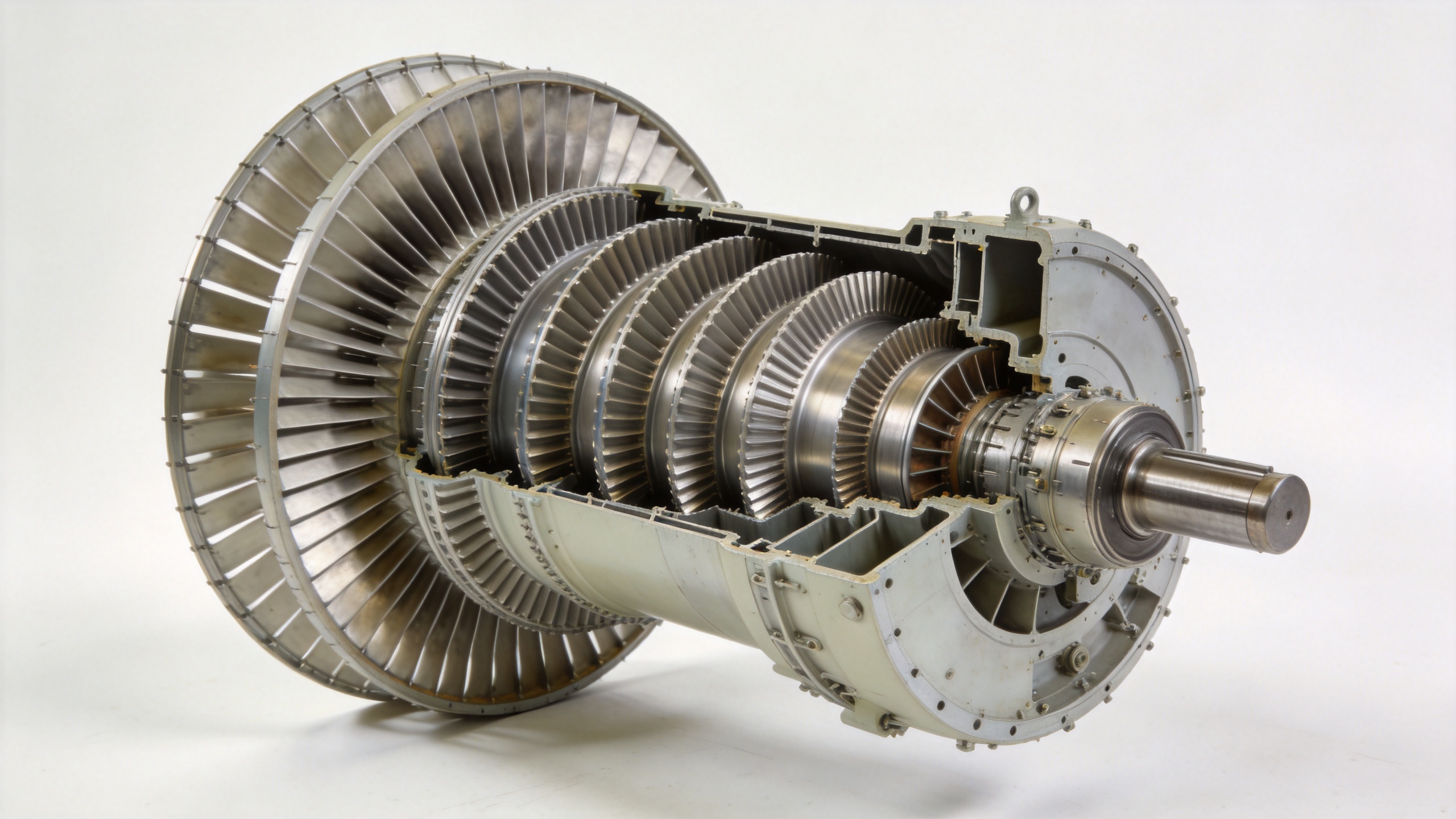
Typical Dimensional Ranges: Span, Chord, and Aspect Ratio
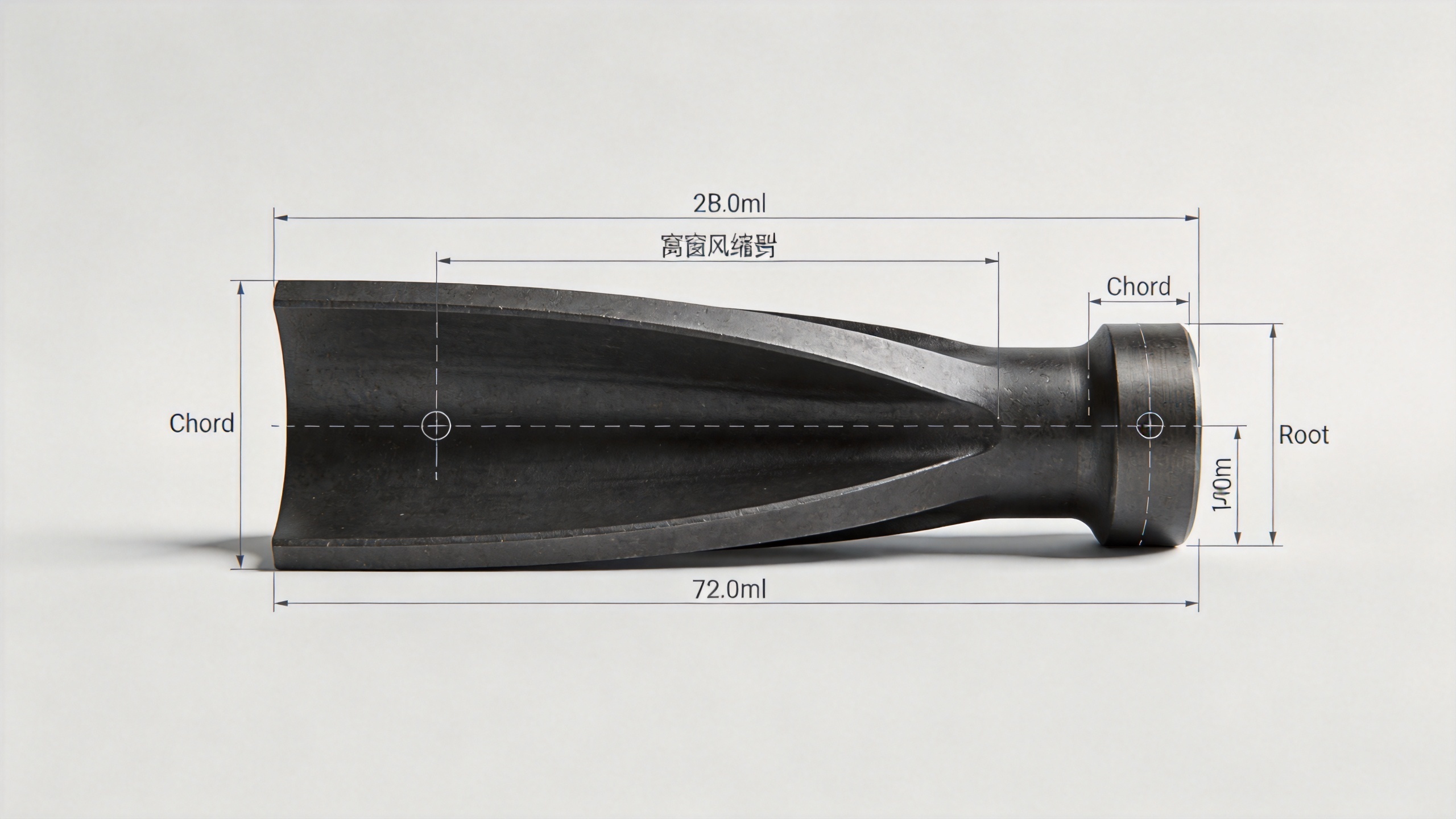
When buyers ask about blade size, they usually mean one of three primary dimensions: blade span (the length from root to tip), chord length (the width of the airfoil from leading edge to trailing edge), and aspect ratio (span divided by chord). Each of these varies considerably depending on the turbine model and stage position.
| Parameter | Small Industrial / Aero-Derivative | Mid-Size Industrial Turbine | Large Power-Generation Turbine |
|---|---|---|---|
| Blade Span (first stage) | 30–80 mm | 80–160 mm | 160–350 mm |
| Blade Span (last stage) | 10–30 mm | 25–60 mm | 40–100 mm |
| Chord Length (typical range) | 20–60 mm | 40–100 mm | 60–180 mm |
| Aspect Ratio (span/chord) | 1.5–3.5 | 1.6–3.0 | 1.6–2.5 |
These are indicative ranges, not hard limits. Actual dimensions depend on the turbine model, OEM design specifications, and whether you are dealing with original or retrofit blade geometry. Industrial gas turbine blade designs have historically used aspect ratios from approximately 1.6 to 2.1 for mid-to-large machines, while research-scale and aero-engine compressors have demonstrated ratios outside this window — sometimes approaching 4:1 in high-aspect-ratio designs or dropping below 1.5 in wide-chord, low-aspect-ratio configurations intended for surge margin improvement.
The Practical Lower and Upper Bounds of What a Forge Manufacturer Can Produce
From a forging production standpoint, blade size range is bounded by two practical constraints: the minimum feature size that a precision forging process can reliably hold to tolerance, and the maximum die envelope and press capacity that a given facility can accommodate.
At Navi Power Technology, our forging capability for gas turbine compressor blades covers a span range from approximately 20 mm to over 400 mm, with chord lengths from roughly 15 mm up to 200 mm depending on the blade profile. Blades within this envelope can be produced with airfoil dimensional tolerances of 0.1–1 mm — which matters because compressor blade aerodynamics are sensitive to profile deviation. A 0.5 mm error on a leading edge radius is inconsequential on a large first-stage blade but significant on a small last-stage blade where the chord itself may only be 25 mm.
For very small blades — below 20 mm span — forging produces a workpiece, but the finishing machining tolerances become the dominant cost and precision challenge. These sizes are more common in micro-turbines or specialized research compressors rather than in large industrial gas turbines.
Custom Blade Size: What Drives the Specification
The more important question for procurement engineers is not what the standard catalogue range is — it is whether a manufacturer can produce a specific blade to the exact dimensions on your drawing. That distinction — between standard-range production and custom blade size production — is where supplier capability matters most.
Custom blade size work typically falls into three scenarios:
- Replacement for a legacy turbine model where the original OEM no longer supplies the part, and no dimensional drawing is available. In this case, the existing blade itself or turbine disk geometry becomes the reverse engineering input.
- Retrofit or upgrade programs where the compressor annulus geometry is being modified, and new blade profiles must be designed or adapted to fit a modified flow path.
- Multi-source qualification where an operator wants to qualify an alternative supplier to a dimensional standard defined by the OEM drawing, requiring close dimensional replication rather than engineering interpretation.
In all three cases, the starting point for a custom blade size engagement is the engineering drawing or the physical blade sample. Navi Power's pre-sales engineering support includes drawing review and specification validation before quotation — because one of the more common procurement risks in custom blade work is discovering a dimensional mismatch between the drawing and the actual turbine installation only after parts arrive on site.
Dimensional Parameters Beyond Span and Chord
Span and chord are the headline dimensions, but a complete blade size specification for a gas turbine compressor includes several additional parameters that must be controlled throughout production:
- Root profile dimensions — the fir-tree or dovetail attachment geometry must match the turbine disk slot exactly; even a small dimensional deviation can prevent proper installation or cause localized stress concentrations.
- Airfoil thickness distribution — the maximum thickness and its chordwise position affect stiffness and aerodynamic loading; this is typically captured in the airfoil section data rather than a single "thickness" number.
- Twist angle and stagger angle — the blade is not a flat plate; it is twisted along the span to account for the radial velocity gradient, and this twist must be reproduced consistently across the production lot.
- Weight and balance — rotor balancing requires that blade weights across one assembly be matched within defined tolerance bands, which means size control is inseparable from mass control in high-speed rotating applications.
A blade that measures correct on span and chord but deviates on root profile or airfoil twist is not a correctly sized blade — it is a dimensional non-conformance that will cause fit or performance problems. Reviewing all dimensional parameters as a system — not just the headline span and chord — is therefore the right approach when specifying or validating a compressor blade order.
What to Bring When You Ask for a Size-Range Assessment
If you are evaluating whether a supplier can produce blades for your specific gas turbine compressor, the most efficient approach is to share the dimensional drawing or blade sample directly rather than asking for a generic capability range. A manufacturer who needs to determine fit from first principles will ask for the same information eventually — the drawing, the turbine model, the stage number, and the required quantity and delivery window.
For compressor retrofit projects where drawings may be incomplete or based on measurements from worn parts, a detailed pre-production inspection and first-article report aligned to your dimensional acceptance criteria will be a more useful deliverable than a capability statement alone. Specifying how you will verify dimensional compliance — coordinate measurement, optical scanning, or pass-through inspection at the manufacturing facility — should be part of the sizing conversation from the start.
Summary
Gas turbine compressor blades span a wide dimensional range: from small last-stage blades with spans below 30 mm in aero-derivative turbines to large first-stage blades exceeding 300 mm in utility-scale power generation turbines. Chord lengths, aspect ratios, root geometry, and profile twist are equally important to span as part of the complete size specification. Precision forging manufacturers can work across this range provided the drawing-based specification is clear and the dimensional tolerance requirements are defined. For custom blade size enquiries — including reverse-engineered legacy blades and retrofit geometries — the engineering drawing or a physical sample is the correct starting point for a meaningful sizing discussion.
To discuss your specific compressor blade dimensions and receive a production feasibility assessment, contact the Navi Power Technology engineering team through our website at compressorblade.com.