 EN
EN

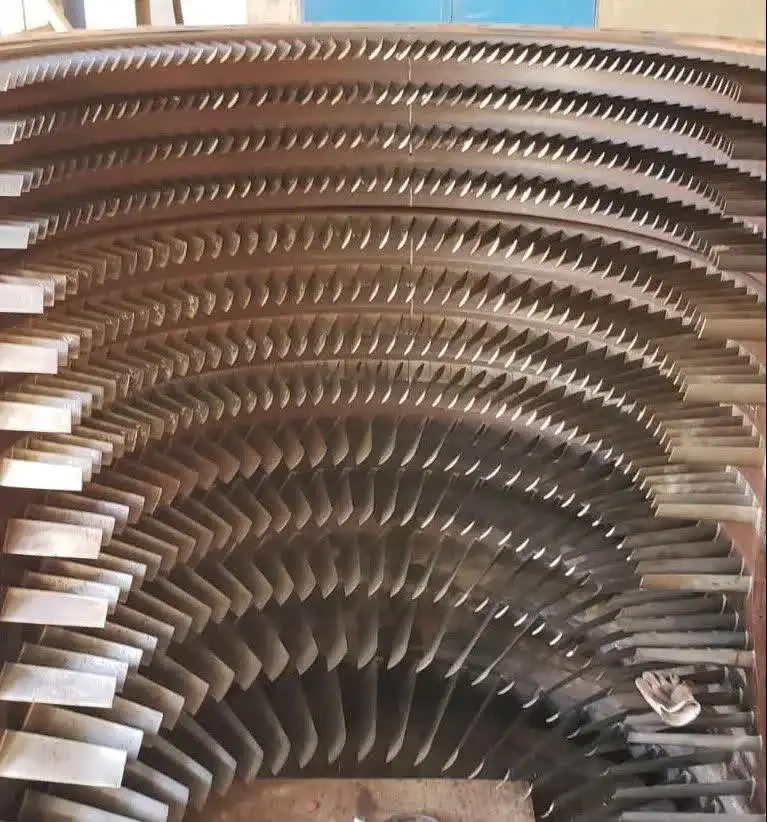
What Surface Anti-Corrosion Treatment For Long-Term Used Stator Vane?
In gas turbine compressor maintenance, one question comes up repeatedly when reviewing overhaul records: why do some stator vanes need replacement after 20,000 service hours while others show minimal degradation at 40,000? In most cases, the answer comes down to surface preparation and coating selection before the vane ever enters service. If you have long-term used stator vanes or are planning protection for a new set, understanding which surface anti-corrosion treatment actually holds up matters more than the initial hardware cost.
Stator vanes sit in the compressor flow path, exposed to inlet air that can carry moisture, salt, sulfur compounds, and industrial particulates depending on the operating environment. Over time, these elements attack unprotected or inadequately coated metal, leading to pitting, surface roughness, and profile loss that degrades aerodynamic efficiency and accelerates further wear. Choosing the right anti-corrosion coating before extended service—and verifying it is correctly specified—is one of the clearest ways to shift from reactive replacement to predictable lifecycle management.
Why Stator Vanes Are Particularly Vulnerable
Compressor stator vanes operate under conditions that make corrosion control more demanding than many assume. Unlike hot-section turbine vanes where thermal oxidation is the primary threat, compressor stator vanes face lower temperatures but higher exposure to moisture-laden or chemically active air. In power generation and industrial turbines running in coastal or humid inland environments, salt deposition and chloride-induced pitting can begin within the first few thousand hours without protective treatment.
The material most commonly used for compressor stator vanes (titanium alloys and stainless steels in lower stages, nickel-based alloys in later stages) has reasonable baseline corrosion resistance but is not inherently immune to the specific chemistry found in industrial and marine-adjacent intake environments. What the base metal cannot prevent, the surface treatment must handle.
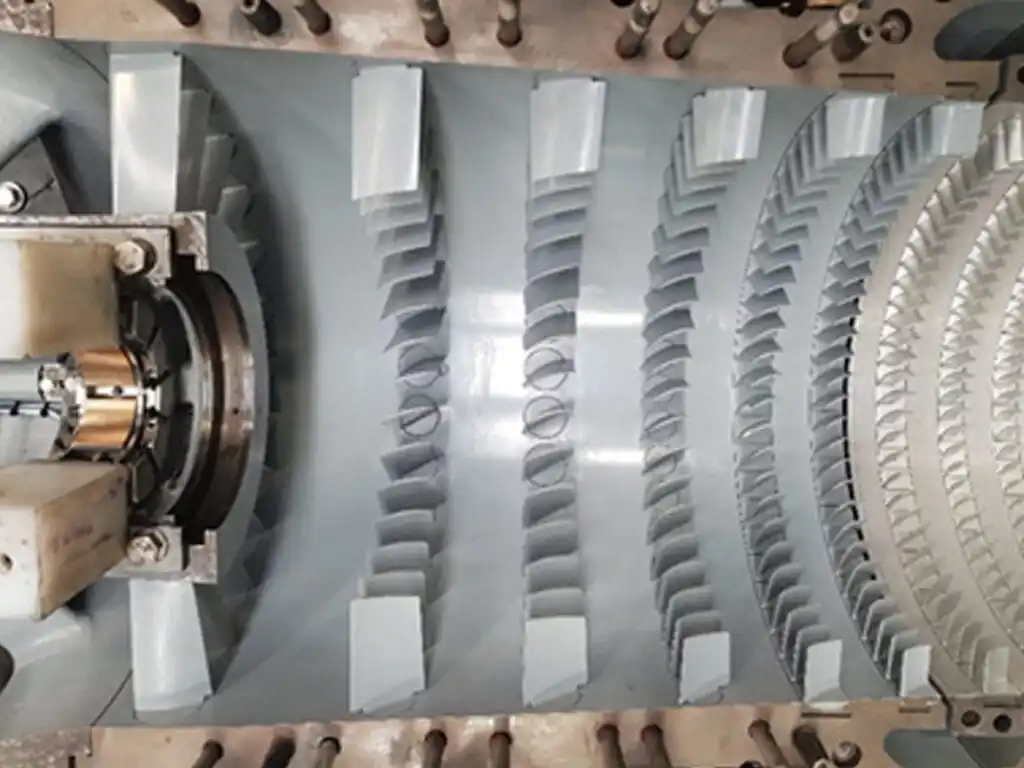 Thermal spray anti-corrosion coating applied to a compressor stator vane—one of several surface treatment methods used for long-term service protection.
Main Anti-Corrosion Treatment Options for Long-Term Use
Aluminide Diffusion Coatings
Aluminide coatings, applied through a pack cementation or chemical vapor deposition process, are among the most established surface treatments for compressor stator and nozzle vanes. The coating diffuses into the base metal surface, forming an alumina-forming intermetallic layer that provides both oxidation and corrosion resistance. US patent US6131800A specifically describes this approach for gas turbine stator vanes, confirming the method's industrial validation.
For long service applications, sacrificial aluminide coatings are particularly relevant. The alumina layer acts as a sacrificial barrier: it corrodes preferentially rather than allowing the substrate alloy to degrade. In MRO programs managing large turbine fleets, aluminide coatings on stator vanes have been a standard specification because they can be stripped and reapplied during overhaul without dimensional change to the airfoil profile, provided the original substrate is within tolerance.
That said, aluminide coatings perform optimally in high-temperature compressor stages where oxidation is co-present with corrosion. In low-temperature front stages exposed primarily to wet corrosion and chloride attack, thermal spray options may provide more targeted protection.
Thermal Spray Coatings (HVOF and Plasma Spray)
High-Velocity Oxygen Fuel (HVOF) and plasma spray coatings apply a dense, well-bonded coating layer onto the stator vane surface without the diffusion mechanism of aluminide treatments. Common coating materials include tungsten carbide (WC), WC-Co(Cr) cermet, chromium carbide (Cr₃C₂), and Stellite alloys, selected based on whether the primary threat is erosion, corrosion, or both.
For long-term used stator vanes in erosive and corrosive environments—industrial power plants drawing air with particulate, for example—HVOF WC-Co(Cr) coatings provide high hardness combined with corrosion resistance. Research on thermally sprayed coatings confirms that carbide coatings achieve excellent wear and corrosion resistance through high hardness and chemical stability of the ceramic phase within the metallic binder matrix.
A critical application parameter to verify: coating thickness should be at least 0.02 mm (20 μm) to provide consistent protection. Coatings below this threshold show cracks and discontinuities that reduce both erosion and corrosion resistance significantly. For refurbishment of worn stator vanes, HVOF coatings can restore dimensional conformance while simultaneously improving surface resistance compared to the original uncoated condition.
Chromate Conversion Coatings
Chromate conversion coatings are a lower-cost option applied to aluminum alloy components and some stainless steel surfaces to provide a thin corrosion-resistant film. They are commonly used on compressor casing components and stator vane platforms rather than airfoil sections, as the coating provides adequate protection for non-aerodynamic surfaces where mechanical contact wear is low.
For airfoil surfaces on stator vanes intended for long service, chromate conversion alone is generally insufficient. It performs acceptably in moderate environments but offers limited resistance to chloride attack, high humidity, and abrasive particle impingement. If used on stator vanes, it is typically as a primer under an additional coating system rather than as a standalone treatment.
Polymer and Epoxy-Based Coatings
Polymer-based coatings, including corrosion-resistant epoxy systems, are used on some compressor stator vanes in environments where non-metallic barrier protection is practical. These coatings provide a moisture and chemical barrier but are limited by temperature range, adhesion durability under vibration, and resistance to mechanical damage from particle impingement.
In experience-based assessment, polymer coatings on compressor stator vanes tend to perform adequately in cleaner environments—natural gas-fueled turbines with dry inlet air—but show early degradation in offshore or coastal installations where combined thermal cycling and moisture exposure challenge adhesion over time. They are better suited to applications where the coating can be easily inspected and reapplied at routine intervals rather than relied upon for extended intervals between overhauls.
How to Select the Right Treatment for Your Application
The most common mismatch in anti-corrosion coating selection is applying a coating that performs well in one environment to a turbine operating in a completely different one. The right starting point is the operating environment, not the coating product data sheet.
- Marine or coastal environments with salt-laden air: Aluminide or HVOF WC-Co(Cr) coatings provide the chloride resistance required; polymer coatings alone are typically inadequate for long-service intervals.
- Industrial environments with mixed particulate and humidity: HVOF carbide coatings address both erosion from particles and corrosion from moisture; coating thickness should be verified at or above the 0.02 mm minimum.
- Clean inlet environments (filtered air, low humidity): Aluminide diffusion coatings or chromate-primed polymer systems may be sufficient, and lower-cost options become more defensible when replacement intervals are short.
- Refurbishment of long-term used vanes with existing wear: HVOF coatings are preferred for dimensional restoration combined with improved surface protection; aluminide can be reapplied if strip inspection confirms the substrate is within serviceable limits.
Material certification matters as much as coating type for long-term used stator vanes. Coatings applied without documented process parameters, batch records, or coating thickness verification are difficult to evaluate at the next inspection interval and create uncertainty in remaining service life assessment. Requesting material certification and coating inspection data as part of the supply or overhaul package is not a bureaucratic step—it is the baseline for confident lifecycle planning.
Comparing Treatment Options at a Glance
| Treatment Type | Suitable Environment | Key Advantage | Limitation |
|---|---|---|---|
| Aluminide (Diffusion) | High-temp stages, moderate corrosion | Strippable, reapplicable, established MRO process | Less effective in pure chloride-wet environments |
| HVOF (WC, Stellite) | Erosive + corrosive, refurbishment | High hardness, thick, restorative capability | Higher cost, specialized equipment |
| Chromate Conversion | Low-wear platform/casing surfaces | Low cost, fast application | Not suitable as standalone for airfoil long service |
| Polymer/Epoxy | Clean inlet, short intervals | Moisture barrier, easy reapplication | Adhesion limits in cyclic thermal environments |
Conclusion
For long-term used stator vanes, surface anti-corrosion treatment is not a cosmetic specification. It directly determines whether the vane reaches the next scheduled overhaul or requires unplanned replacement. Aluminide diffusion coatings remain the industry standard for general compressor corrosion protection with a well-established MRO strip-and-reapply cycle. HVOF thermal spray coatings provide a stronger option for erosive or chemically aggressive environments and for refurbishing worn vanes to serviceable dimensions with improved surface resistance.
The key shift in long-term maintenance planning is moving from "what coating is available" to "which coating matches this turbine's inlet environment and target overhaul interval." Coating selection at that level, with verified thickness, documented material certification, and inspection data, consistently outperforms general-purpose treatment applied without environment-specific justification.
If you are sourcing stator vanes or evaluating surface treatment options for your compressor maintenance program, working with a supplier that provides both coating process documentation and dimensional inspection records gives you the traceability foundation that reactive maintenance programs typically lack.